Juliette Bourdier, “Un manuscrit parisien et ses énigmes”, livre d’heures des Le Tellier, 1460”, PECIA, n°24, Brepols, 2022 : 289-333.
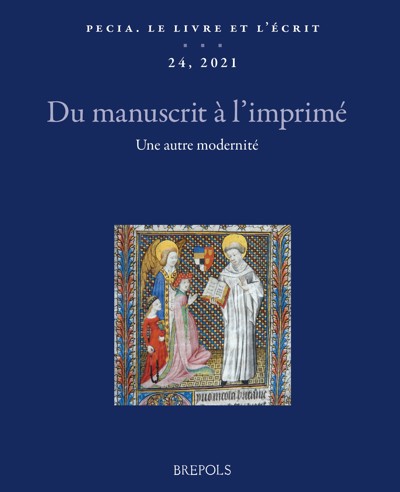
Au XVe siècle, la transition entre le manuscrit et l’imprimé s’est faite progressivement, les premiers incunables ressemblant à s’y méprendre aux manuscrits contemporains, notamment au niveau de la présentation du texte. La rupture s’est amorcée au cours de la première moitié du siècle suivant. Le présent volume s’intéresse particulièrement à cette époque de bouleversement culturel avec des contributions diverses mais toutes relatives au cœur même de cette revue: le livre et l’écrit.
In the fifteenth century, the transition from manuscript to print was gradual, with the first incunabula closely resembling contemporary manuscripts, notably in terms of the presentation of the text. The transformation began in the first half of the following century. The present volume is particularly interested in this period of cultural upheaval, offering varied contributions, yet all related to the very heart of this journal: the book and the written word.
Un manuscrit parisien et ses énigmes

Le manuscrit Le Tellier est un livre d’heures pour un usage parisien, daté de la deuxième moitié du xve siècle. Faisant partie d’un fond privé, il est conservé en Caroline du Sud, aux États-Unis. En l’état, l’ouvrage mesure 172 × 118 mm et comporte deux-cent-vingt-deux folios de parchemin écrits à l’encre brune à plusieurs mains, vingt-six illuminations pleine-page, mille-cinq-cent-soixante-douze lettres ornées, ainsi que deux-cent-trente-quatre marges florales et des centaines d’autres marqueurs décorés. L’ouvrage rédigé en latin, et rubriqué en latin et en français, offre un recueil complet d’offices hiérarchisé par un traitement ornemental précieux et soigné. Il est en parfait état de conservation mis à part quelques effacements partiels de lettres et d’images par mouillage, usure ou frottement, et de très rares mouillures et brunissures du parchemin. Il est protégé par une reliure du xviie siècle et a appartenu au xviiie siècle à la bibliothèque des Le Tellier de Montmirail-Courtanvaux, premier propriétaire connu[1]. Le manuscrit a été expertisé pour les besoins de transactions, mais n’a jamais fait l’objet d’une étude ; son acquéreur m’en a donc confié l’exploration[2]. Nous ferons ici une rapide description de cet énigmatique ouvrage, dont chaque découverte soulève un nouveau mystère et partagerons les résultats d’une étude en cours, s’intéressant à l’histoire du manuscrit, son usage ainsi que sa description textuelle et picturale.

The Le Tellier manuscript, book of hours, use of Paris (c. 1460) in Latin and French ; from a private collection in South Carolina, Unites-States ; (172 × 118 mm), Vellum ; AD + 222 + E-H. This manuscript is written by several hands in gothic liturgical, in dark brown ink with rubrics painted in red, between two verticals and 16 horizontals, on a velum ruled in red. The text capitals are touched in yellow, and the prayers are highlighted with one-line initials and lineendings in burnished gold on grounds of pink and blue patterned with white tracery. Along the manuscript, hundreds of two-three-and four-line initials in blue or pink, patterned with white tracery and foliate infills on burnished gold grounds mark the offices and prayers. An unusually rich cycle of decoration adorns this colorful Parisian book of hours, including hundreds of panel borders in left margin of fine burnished gold leaves and disks on hairline tendrils and stems among acanthus leaves in gold and blue and sprays of colored flowers and fruits. The center of this artefact remains the twenty-six large miniatures in full color and gold placed in arched compartments with ornamented baguettes frames and full decorated borders. These highly detailed paintings result from the meticulous work of several artists, they depict various traditional scenes from the life of the Virgin Mary and the passion of Christ. While the illumination and the texts indicate that the manuscript was intended for use of Paris, several details deserve attention, in particular regarding its production. In this paper, we intend to give a brief description of this amazing manuscript mainly produced in Paris ; and to point out some textual and iconographic features which are of particular interest for the understanding of medieval methods of « mass production » of fine Books of Hours in the second half of the fifteenth century Paris.
 Juliette Blue Bourdier, Medievalist
You must be logged in to post a comment.